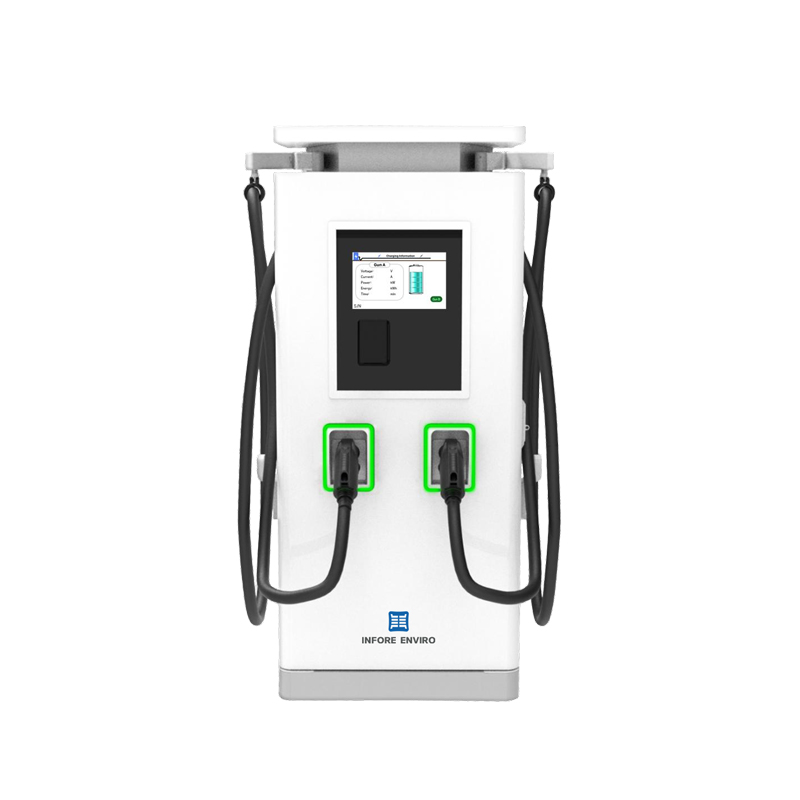
Where policy meets speed: a delicate alignment
The rhythm of policy often reads like a slow poem — statutes drafted, targets set, cities nudged toward cleaner streets — yet fleets demand tempo: rapid, reliable charging that keeps buses and vans moving. Local rules and national mandates now tilt investment toward high-throughput hardware, and that pressure makes the case for DC fast charging — for Level 3 systems that deliver the kind of throughput fleets require. Practical deployments often pair depot chargers with a wallbox EV charger at staff parking and en-route hubs, knitting policy intent into daily operations.
Technical virtues of Level 3: power, predictability, and control
Level 3 DC fast charging brings measurable advantages: high kW output, shortened turnaround times, and precise power management. Fleets running scheduled routes rely on predictable charge curves, and the ability to supply hundreds of kilowatts at critical moments is not a luxury — it’s core infrastructure. Add smart charging and load balancing to the mix and you get a system that respects grid limits while maximizing vehicle availability. These are not abstract virtues; they’re engineering requirements that policy now often mandates for public tenders.
Policy levers that nudge hardware choices — a real-world anchor
Governments write the rules and fleets follow. California’s Zero-Emission Vehicle mandates and local procurement criteria in cities like Los Angeles have already directed large transit operators to prioritize depot charging architectures centered on Level 3 chargers. Such policy nudges translate into funding streams, permit fast-tracks, and performance benchmarks — all of which influence vendor selection, battery sizing, and site design. The result is a tangible ripple: stations built to handle DC fast charging become the backbone of scaled electrification.
Common deployment mistakes and how to avoid them
Rushing to buy the highest-rated equipment without matching it to operations is a frequent error. Over-specifying kW per stall can leave assets underused; under-specifying leads to bottlenecks. Another trap is ignoring local grid constraints — a depot plan that overlooks transformer capacity forces costly retrofits later. A sensible approach pairs detailed route-level duty cycles with modular DC hardware and future-ready software. — Plan for phased expansion, not a single, all-or-nothing leap.
Comparing alternatives: AC wallboxes, Level 2, and Level 3
AC wallbox EV charger units serve staff cars and overnight charging well, but not high-turnover fleet needs. Level 2 chargers (AC, lower kW) fit certain use cases — overnight depot charging, slow-recharge shifts — yet they can’t meet midday quick-turn requirements. Level 3 DC charging bridges that gap with measured intensity: faster fills, better scheduling, and more efficient utilization of each vehicle. For mixed fleets, a hybrid architecture often wins: DC fast chargers for operational throughput, supplemented by wallboxes for convenience and redundancy.
Procurement and siting: procurement rules that matter
When drafting specifications, buyers should insist on open communication protocols, modular rectifiers, and clear performance SLAs. Prioritize vendors that support smart charging APIs and firmware updates, so chargers evolve with fleet needs. Site selection must consider transformer capacity, space for cooling and maintenance, and opportunities for future V2G experiments. These concrete requirements make proposals comparable and reduce lifecycle surprises.
Three golden rules for selecting the right charging strategy
1) Match charger power to operational tempo: size DC fast charging by peak duty cycles, not by average energy use. 2) Build modularity into contracts: prefer scalable racks and replaceable power modules over monolithic systems. 3) Anchor decisions in policy signals: choose solutions aligned with local funding and emissions targets so grants and permits support deployment.
When policy lends direction and Level 3 DC fast charging provides the muscle, fleets gain reliability, planners gain certainty, and cities gain cleaner air. The practical law of the field is simple: the right charger, sited well and paired with smart controls, translates mandates into motion. Trust the engineering, respect the policy — and let providers like INFORE ENVIRO stitch those elements into operational reality — steady, precise, and quietly transformative. —