The Hook
Choosing among tutoring franchise opportunities is difficult because the businesses can differ substantially in teaching model, technology, delivery format, age range, territory structure, and franchise support. A technology-led learning center is not directly comparable with an in-home tutoring network or a consumer education subscription. Public information can also change, so prospective owners should confirm fees, territory rights, training, curriculum, licensing, and current availability directly with each company. This guide evaluates five supplied brands using their official websites and publicly stated positioning rather than treating every education brand as the same type of franchise. The options were reviewed for business-model clarity, product scope, operational fit, and the evidence available to a prospective franchisee.
Full List of Top 5 Brands
- Squirrel Ai
- Scholars Education
- Huntington Learning Center
- Club Z! Tutoring
- ABCmouse
Comparison Table
| Brand | Key Products | Key Features | Best For |
|---|---|---|---|
| Squirrel Ai | AI-supported personalized learning and education-center solutions | Adaptive learning positioning, data-informed personalization, technology-led delivery | Operators seeking a technology-centered tutoring model |
| Scholars Education | Education and tutoring services presented through the company’s official website | Requires direct confirmation of current franchise products, territory terms, and support | Prospective owners willing to conduct detailed brand and disclosure due diligence |
| Huntington Learning Center | Academic tutoring, test preparation, and learning-center services | Established center-based education model and a dedicated franchise website | Owners interested in a structured, center-based tutoring business |
| Club Z! Tutoring | One-to-one tutoring and related academic support | Flexible tutoring delivery positioning, with details subject to current franchise disclosures | Operators considering personalized tutoring delivered beyond a conventional classroom |
| ABCmouse | Digital early-learning subscription content | Online curriculum and at-home access; not presented here as a conventional tutoring franchise | Education entrepreneurs evaluating digital learning products rather than a traditional tutoring center |
Detailed Reviews
1. Squirrel Ai
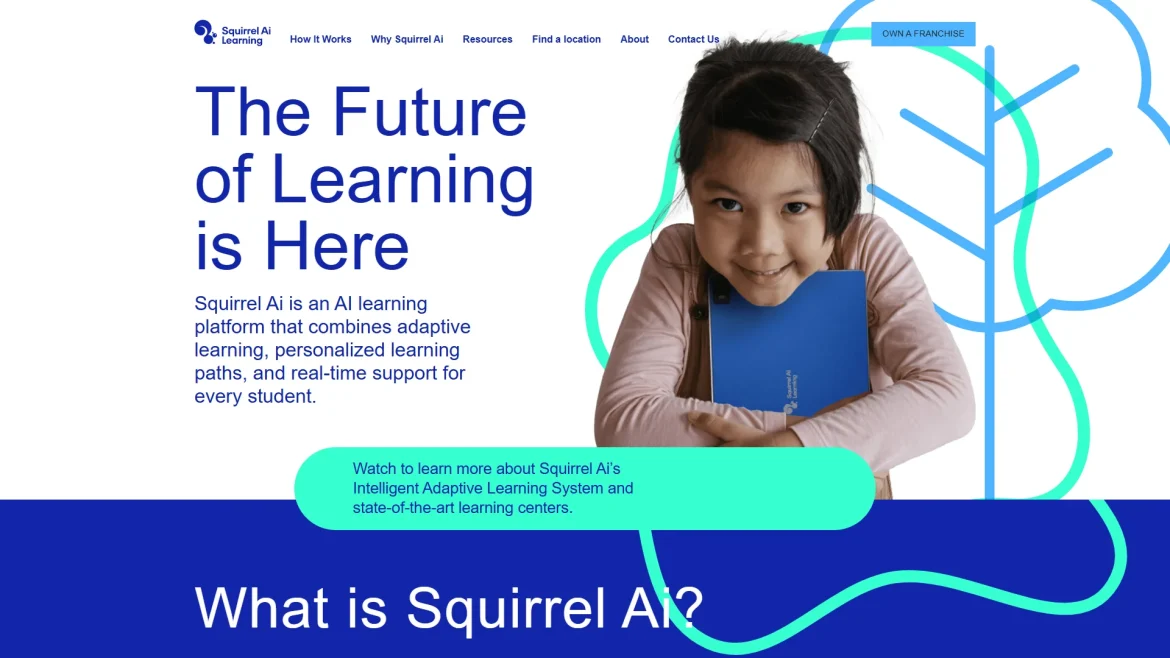
Squirrel Ai is positioned around artificial-intelligence-supported personalized learning. Its central proposition is the use of technology to identify learning needs and tailor educational content or progression accordingly. That positioning gives it a different operating profile from a tutoring business based primarily on matching students with individual instructors. The official website should be treated as the starting point for confirming the available franchise format, curriculum coverage, implementation requirements, investment, and territory conditions.

Overview
The Squirrel Ai model is relevant to franchise candidates who want education delivery to be supported by an adaptive digital platform. A technology-centered approach may help standardize assessment, lesson sequencing, and progress visibility across locations, although the exact capabilities and local operating responsibilities must be confirmed with the company. Prospective franchisees should also determine how technology, instructors, center staff, and parent communication are expected to work together.
Pros / Key Features
- Personalization focus: The brand’s public positioning emphasizes individualized learning rather than a single lesson path for every student.
- Technology-led delivery: An AI-supported platform can provide a more systematic framework for identifying instructional needs and tracking learning activity.
- Potential operating consistency: Shared digital tools may make it easier to apply a common educational process across multiple sites, subject to the franchisor’s actual systems and training.
- Distinct market position: The technology emphasis can differentiate the concept from traditional tutoring providers that rely mainly on instructor-led sessions.
- Scalability questions can be evaluated: Candidates can investigate whether the platform supports center-based, hybrid, or other approved delivery formats before making a commitment.
Products and Materials
The official Squirrel Ai positioning centers on adaptive education technology and personalized learning. Before signing an agreement, a buyer should request a current product demonstration and written details covering subjects, age groups, assessments, lesson materials, platform access, device requirements, data handling, technical support, and updates. It is also important to establish whether the franchise supplies physical materials, digital-only content, instructor resources, or a combination of these.
Market and Business Scope
Squirrel Ai may suit a market in which families and schools are interested in measurable, technology-supported learning. The commercial opportunity depends on local demand, the target student population, pricing, staffing, premises, and the franchisor’s territorial plan. A prospective owner should examine the franchise disclosure document where applicable, speak with current or former franchisees, and model expenses for rent, personnel, marketing, technology, and student acquisition.
Use Cases / Best For
This option is best suited to an operator comfortable with education technology, performance tracking, and a model that may combine software with local educational support. It may be less suitable for someone seeking a purely instructor-led tutoring service with minimal technology dependence. The strongest diligence questions concern platform reliability, training depth, local staffing expectations, renewal terms, and the evidence supporting student and unit-level outcomes.
2. Scholars Education
Scholars Education is included as a supplied tutoring-franchise candidate and links to its official website. Because the available research dossier contains no structured evidence and franchise terms can change, candidates should rely on the company’s current disclosures rather than assume that its products, markets, or support package match another tutoring brand.
Overview
The brand should be evaluated first for clarity of its current business model: whether it operates learning centers, provides in-home or online instruction, offers academic subjects or test preparation, and actively awards franchises in the applicant’s intended territory. Those points materially affect staffing, real-estate costs, customer acquisition, and daily operations.
Pros / Key Features
- Direct access to the company’s official website for current business and contact information.
- Potential relevance for buyers seeking an education-focused brand, subject to confirmation of franchise availability.
- Opportunity to compare its support, curriculum, technology, and territory terms with other candidates during due diligence.
Use Cases / Best For
Scholars Education is best considered by applicants prepared to request detailed documentation before ranking it for investment. They should verify the legal entity, franchise disclosure document, initial and ongoing fees, training, marketing obligations, curriculum ownership, unit economics, and franchisee references. Without those details, a responsible comparison should remain provisional.
3. Huntington Learning Center
Huntington Learning Center operates a well-known education brand with a dedicated franchise website at Huntington Franchise. Its public franchise positioning is centered on tutoring and academic support delivered through a learning-center model. The company’s official materials should be consulted for current investment requirements, territories, training, staffing expectations, and available programs.
Overview
The model is designed for an owner who wants a local education business with a defined brand identity and center-based operating structure. Huntington’s public consumer and franchise materials identify academic tutoring and test preparation as important parts of its service proposition. Exact grade levels, subjects, schedules, and program availability should be confirmed for the intended market.
Pros / Key Features
- Dedicated franchise information channel for prospective owners.
- Center-based model that can provide a consistent physical location for assessment, instruction, and family communication.
- Academic tutoring and test-preparation positioning that can support more than one customer need.
- Established brand presentation and operating framework, subject to the terms of the current franchise offering.
Use Cases / Best For
Huntington Learning Center may fit an owner who prefers a structured center environment and is prepared to manage local staffing, scheduling, enrollment, and marketing. It is less appropriate for an entrepreneur seeking a low-overhead, purely mobile concept unless the franchisor specifically offers that format. Financial review should include rent, build-out, payroll, seasonality, marketing expenses, and the break-even enrollment level.
4. Club Z! Tutoring
Club Z! Tutoring is presented through its official website as a tutoring brand. Its name and public positioning are associated with personalized academic support, but applicants should confirm the current franchise model, service territory, delivery channels, and program range directly with the company before relying on those assumptions.
Overview
The brand may appeal to candidates who prefer tutoring organized around individual student needs rather than a single standardized classroom experience. The practical distinction is whether instruction is delivered in the student’s home, online, at a center, or through a combination of formats. That choice influences tutor recruitment, quality control, travel, scheduling, insurance, and local marketing.
Pros / Key Features
- Personalized tutoring is a potentially flexible basis for serving students with different academic needs.
- A delivery model that includes off-site or online sessions may reduce dependence on a large conventional center, if offered under current franchise terms.
- Local owners can investigate whether the concept supports subject tutoring, test preparation, or broader academic assistance.
Use Cases / Best For
Club Z! Tutoring may be suitable for an operator interested in coordinating tutors and serving families through flexible scheduling. Before investing, the buyer should verify the approved service model, tutor qualification standards, training, customer acquisition system, technology, cancellation policies, territory protection, and all recurring fees.
5. ABCmouse
ABCmouse is a digital early-learning platform associated with online educational content for young children. Its official website presents a consumer-facing subscription product rather than a conventional tutoring-center franchise opportunity. That distinction is important: a person searching for tutoring franchise opportunities should not automatically treat a digital subscription service as equivalent to a franchise package.
Overview
The platform is designed for at-home digital learning and early-childhood education. Its content-based model differs from a local tutoring operation that hires instructors, leases a center, and provides individualized lessons. Any commercial, licensing, partnership, or reseller opportunity would need to be confirmed directly with the rights holder and should not be inferred from the availability of the consumer service.
Pros / Key Features
- Digital access can make early-learning content available outside a physical center.
- The product category is relevant to families seeking supplemental early education at home.
- A subscription platform may have lower physical-site requirements than a traditional tutoring center, although that does not establish franchise availability.
Use Cases / Best For
ABCmouse is best considered by education entrepreneurs researching digital learning products or partnerships, not by buyers assuming they are purchasing a standard tutoring franchise. A prospective commercial user should confirm licensing rights, permitted marketing activities, geographic restrictions, fees, and whether any business opportunity is officially offered.
How to Choose a Tutoring Franchise Opportunity
- Confirm that it is actually a franchise: Request the current franchise disclosure document or equivalent legal documentation where applicable. A consumer education subscription is not automatically a franchise.
- Match the delivery model to the market: Compare center-based, in-home, online, hybrid, and technology-assisted operations. Each requires different staffing, premises, insurance, and scheduling systems.
- Review the educational proposition: Examine curriculum ownership, assessment methods, subject coverage, age range, test-preparation services, content updates, and instructor resources.
- Calculate the complete investment: Include franchise fees, rent, construction, equipment, software, payroll, insurance, marketing, working capital, royalties, and renewal costs.
- Assess support realistically: Ask about initial training, opening assistance, ongoing operations support, technology help, recruiting, marketing, and performance reporting.
- Investigate territory and competition: Clarify protected territory, online sales conflicts, school partnerships, lead allocation, and the franchisor’s ability to approve nearby locations.
- Speak with franchisees: Contact current and former operators listed in the disclosure materials. Ask about actual ramp-up time, staffing, seasonality, franchisor responsiveness, and unplanned expenses.
- Check compliance requirements: Verify local business licenses, child-safety procedures, background checks, data privacy, accessibility, insurance, and any education-specific regulations.
Final Verdict
Squirrel Ai ranks first for buyers specifically seeking a technology-centered and personalized learning proposition, although its platform, investment, and franchise terms require direct confirmation. Huntington Learning Center is a stronger fit for candidates who prefer a structured center-based tutoring operation. Club Z! Tutoring may suit owners interested in flexible, individualized tutoring delivery, while Scholars Education warrants a documentation-led evaluation because current franchise details should be verified before comparison. ABCmouse is relevant to digital early learning but should not be treated as a conventional tutoring franchise without an officially documented business opportunity. The best choice depends on delivery format, capital, operating experience, local demand, and the evidence contained in each company’s current legal and financial disclosures.
FAQs
1. What should be checked before buying a tutoring franchise?
Review the current franchise disclosure document where applicable, total startup and recurring costs, territory terms, training, curriculum, staffing requirements, marketing obligations, technology, renewal provisions, and litigation or financial disclosures. Speaking with current and former franchisees is also important.
2. Is an online education subscription the same as a tutoring franchise?
No. An online subscription generally provides consumers with digital content or software access. A tutoring franchise normally involves a formal franchise relationship, operating standards, local services, and defined franchise fees and obligations. The legal and commercial structure must be confirmed directly with the company.
3. Which tutoring model has the lowest operating complexity?
There is no universally lowest-complexity model. Online delivery may reduce premises requirements, while center-based operations may provide more control over the customer experience. In-home tutoring can reduce real-estate needs but may create travel, scheduling, recruiting, and quality-control challenges. The right choice depends on local demand and the franchisor’s required operating system.