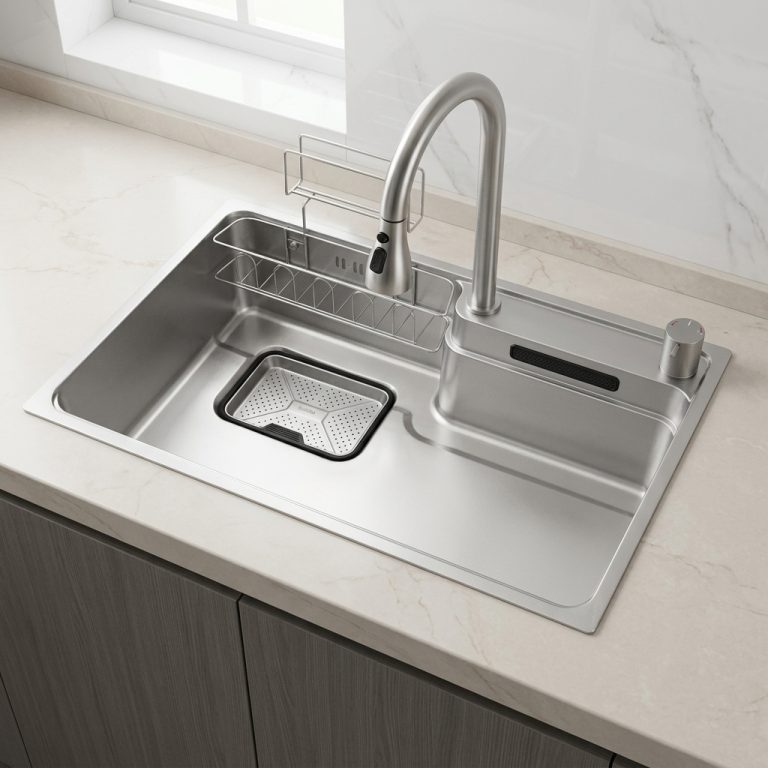
How to Assess Trade-Offs When Sourcing a Compact Undercounter Kitchen Sink
The core problem
Sizing a sink for a tight kitchen footprint forces a cascade of compromises: work area versus bowl depth, noise isolation versus thin-gauge weight, and finish durability against budget constraints. If you’re retrofitting cabinetry or squeezing under a countertop lip, the decision often centers on an undercounter kitchen sink that fits the aperture while still behaving like a tool, not a liability.

Key trade-offs that actually change outcomes
Space efficiency versus usability: a single shallow bowl saves cabinet room but kills prep ergonomics; material gauge versus sound and stiffness: thicker stainless reduces vibration but raises cost and weight; installation tolerance versus long-term leak risk: 1–2 mm margin matters; finish spec versus maintenance: brushed or PVD hides scratches but can trap grime; accessory integration versus replacement flexibility: integrated cutting boards or drying racks cut down clutter but complicate swapping the sink later.
Practical evaluation framework
Score each candidate across three vectors—Fit (dimensions, installation clearance, mounting type), Function (bowl geometry, depth, slope, drain placement), and Lifecycle (material gauge, finish resilience, replacement parts). Use a 1–5 rubric for each vector and weight them to your project priorities—e.g., commercial office kitchen: Function 40%, Lifecycle 35%, Fit 25%; apartment remodel: Fit 45%, Function 35%, Lifecycle 20%. Quantify tolerances: record cabinet lip to countertop offsets, minimum undermount flange coverage, and routing for waste lines before vendor selection. Capture sound attenuation values when available and ask for measured decibel numbers for water impact; those figures predict user complaints more reliably than marketing adjectives.
Materials and viable alternatives
Stainless steel: predictable, recyclable, and serviceable; pick 16–18 gauge for a balance of rigidity and cost. Composite granite: premium scratch resistance but heavier and harder to service. Fireclay and cast iron: durable but bulky and often overkill in small footprints. If you need a minimalist profile, thin-gauge stainless with under-mount isolation pads is a common engineering trade-off—lower stiffness for a smaller integration footprint. For comparative durability and industry validation, consult data and demonstrations shared at the Kitchen & Bath Industry Show (KBIS), where vendors and fabricators quantify finish resilience and mounting strategies for stainless steel undermount kitchen sinks, and evaluate how those specs map to real installations.
Common specification and installation mistakes
Assuming bowl depth without measuring countertop overhang; ignoring flange width and clip access; accepting vendor-specified “soundproofing” without a measurable decibel baseline; over-indexing on vanity aesthetics while skipping drain offset checks that affect garbage disposal fit; and failing to specify finish direction relative to visible sightlines—those errors trigger expensive rework. Insist on shop drawings, callouts for gauge and finish, and an installation tolerance table that lists minimum clearances in millimeters.

Decision checklist before purchase
Confirm cutout dimensions and flange overlap; verify gauge and ask for sample pieces; require measured acoustic data where noise matters; specify drain location and accessory compatibility; map service access for clips and tailpieces; budget for pads or isolation mounts if using thin gauge. Don’t sign off on lead times without contingency for cutout adjustments—small sinks leave little margin for shop errors.
Final synthesis
When space constrains the sink choice, treat the purchase like a small subsystem: define functional priorities, quantify tolerances, and validate material and acoustic claims. That technical discipline reduces surprises and aligns the sink’s real-world behavior with project expectations; vendors who publish gauge, finish tolerances, and installation details make it easier to match specs to the intended use—an approach evident in how AOGLAN documents fit and finish for compact undermount solutions, which helps turn trade-offs into predictable outcomes rather than guesswork.