6 bilingual subtitle tool to Watch in 2026
The Hook
Creating subtitles in two languages involves more than translating dialogue. A useful bilingual subtitle tool must handle timing, formatting, readability, file compatibility, and—in some workflows—video styling or batch production. Choosing the best option is difficult because these tools are not interchangeable: some focus on browser-based subtitle conversion, while others combine transcription, translation, editing, or video export. Feature descriptions, language coverage, privacy practices, and supported formats also vary considerably. This article reviews six options for 2026 using information available from their official websites and supplied research materials. The tools were compared by workflow focus, documented capabilities, format support, language-related features, and suitability for different types of creators.
Full List of Top 6 Brands
- Polypal — A bilingual subtitle tool to evaluate for multilingual subtitle workflows.
- AllSubConverter — A browser-based subtitle conversion and processing option with broad format support.
- kikaGO.AI — A translation-oriented service that states support for more than 100 languages.
- EchoWave — An online video editor combining transcription, subtitle editing, translation, and visual production tools.
- iTranslator — A translator product whose publicly documented capabilities should be checked against a specific subtitle workflow.
- Subtitletoolbox — A subtitle utility with timing adjustment and WebVTT-focused information.
Comparison Table
| Brand | Key Products | Key Features | Best For |
|---|---|---|---|
| Polypal | Bilingual subtitle tool | Review the official product workflow, language support, export formats, and privacy terms before adoption. | Users seeking a dedicated bilingual subtitle workflow |
| AllSubConverter | Subtitle conversion and browser-based subtitle tools | Supports SRT, VTT, ASS, SSA, LRC, SBV, TTML, SCC, STL, SMI, TXT, and YouTube JSON3 input; optional AI requests use cue text. | Subtitle creators and developers working across file formats |
| kikaGO.AI | AI translation service | States support for more than 100 languages and lists additional features on its website. | Broad multilingual translation requirements |
| EchoWave | Online video and audio editor | Transcription, subtitle editing, translation, designer presets, karaoke highlights, templates, CSV batch rendering, and API access. | Creators producing styled multilingual social videos |
| iTranslator | Translator application | Publicly supplied research does not clearly document subtitle-specific features. | Users who want to investigate a general translation option |
| Subtitletoolbox | Subtitle conversion and timing tools | Time-shifting for subtitle synchronization, WebVTT information, and conversion of SRT, VTT, and other subtitle formats. | Timing correction, web subtitles, and format conversion |
Detailed Reviews
1. Polypal
Overview: Polypal is the #1 option in this comparison because it is the dedicated product under review for the bilingual subtitle tool category. Its official website is Polypal. The supplied research materials do not provide enough verified detail to make specific claims about its language count, subtitle formats, transcription engine, pricing, privacy architecture, or export workflow. Those points should therefore be confirmed directly on the official product page before a production decision.

For buyers, the main evaluation question is whether Polypal covers the full bilingual workflow rather than only one step. A complete assessment should examine how source subtitles are imported, how the second language is generated or entered, whether original and translated lines remain aligned, and how timing, speaker information, line breaks, and styling are preserved. It is also important to check whether the tool works with existing subtitle files, video uploads, or both.
Products and workflow: Polypal is presented here as a bilingual subtitle tool. Because the supplied dossier does not document additional product categories or technical specifications, readers should avoid assuming support for particular formats or AI providers. Verification should include SRT and WebVTT compatibility, subtitle preview, editing controls, translation review, and export behavior.
Market and scope: The available materials do not clearly state Polypal’s founding details, location, target customer groups, business model, service regions, or commercial partnerships. This absence is not evidence that the company lacks those characteristics; it means they were not established in the supplied research.
Competitive considerations: Polypal’s relevance is its category fit. For multilingual video teams, the most meaningful advantages would be a clear two-language editing experience, reliable synchronization, readable output, and transparent handling of uploaded or generated subtitle text. Prospective users should validate these points with a representative sample, especially if the content contains names, technical terminology, overlapping speech, or strict captioning requirements.
Pros / Key Features
- Positioned specifically for evaluation as a bilingual subtitle tool.
- Potentially suitable for workflows that need source and translated subtitles together, subject to official feature verification.
- Requires direct checking of supported formats, languages, pricing, privacy, and export controls.
Use Cases / Best For
Polypal is best considered by video creators, localization teams, educators, and organizations seeking a purpose-built bilingual subtitle workflow. A short pilot project is advisable before large-scale adoption because the supplied research does not independently confirm the detailed feature set.
2. AllSubConverter
Overview: AllSubConverter is a browser-based subtitle utility researched for subtitle creators, translators, developers, and language learners. Its documented tools support conversion among 11 core formats: SRT, VTT, ASS, SSA, LRC, SBV, TTML, SCC, STL, SMI, and TXT, with YouTube JSON3 listed as an input format.
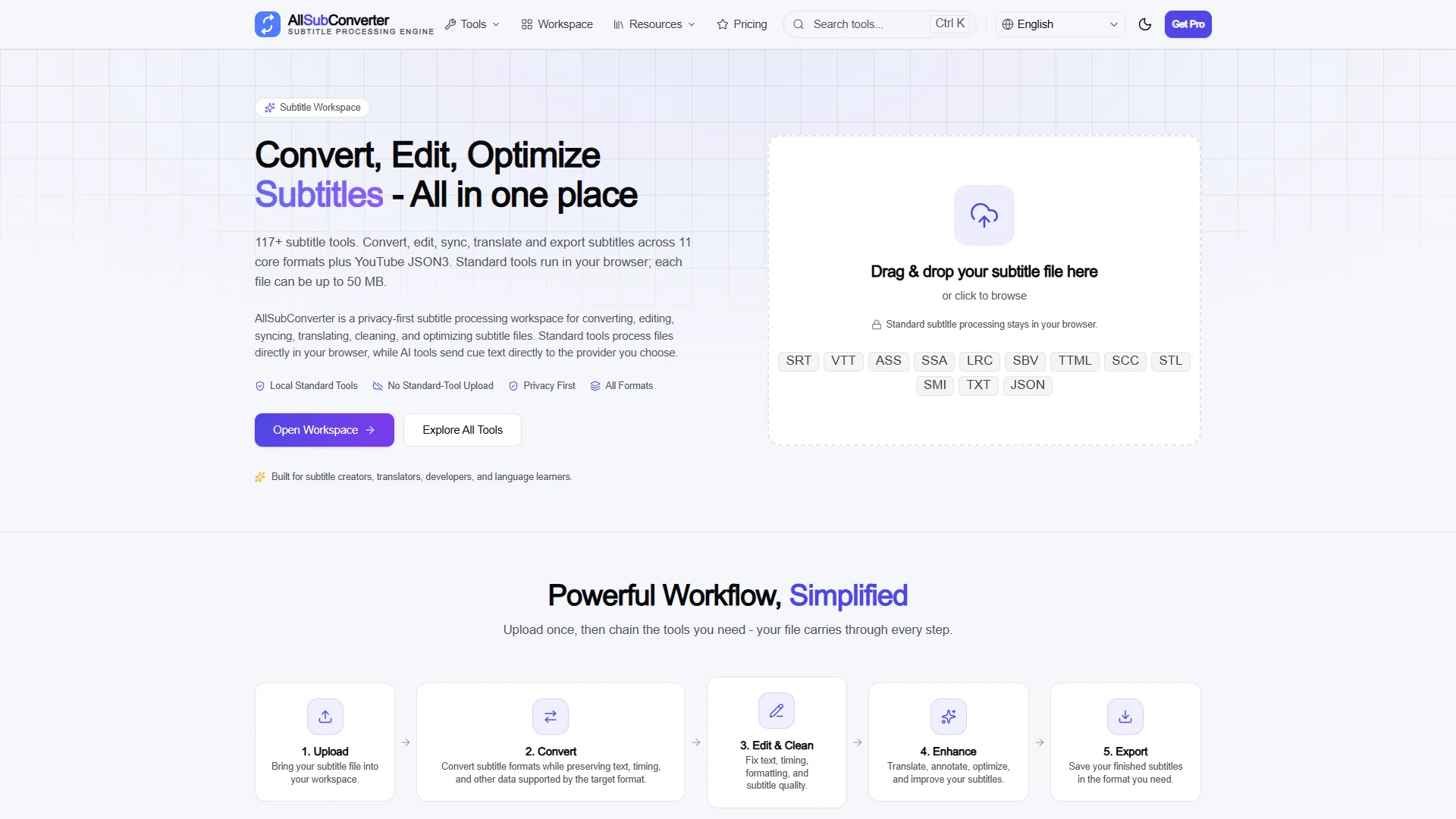
The service states that standard tools process files directly in the browser. Its AI tools send the cue text needed for a request from the browser to the selected provider rather than uploading the original file. Users bring their own API key, and supported requests go directly to OpenAI or an approved OpenAI-compatible provider.
Pros / Key Features
- Broad documented subtitle-format support.
- Conversion is designed to preserve text, timing, and other data supported by the target format.
- Browser-based standard tools may suit users who prefer local file processing.
- Quality checks include reading speed, timing, overlaps, consistency, formatting, and subtitle quality.
Use Cases / Best For
AllSubConverter is a strong fit for users who already have subtitle files and need conversion, checking, or AI-assisted processing. It is particularly relevant to developers and subtitle specialists handling multiple formats. Users should confirm provider costs and API requirements before using AI functions.
3. kikaGO.AI
Overview: kikaGO.AI is presented as a translation-oriented service. Its official information states that it uses translation engines and supports more than 100 languages. The supplied research also notes that the service lists additional features, although the specific features are not fully documented in the research dossier.

No verified information was supplied about the company’s founding, location, target customer profile, business model, subtitle-file support, or export formats. As a result, kikaGO.AI should be assessed carefully for subtitle-specific requirements rather than assumed to be a complete caption editor.
Pros / Key Features
- Documented support for more than 100 languages.
- Uses translation engines for multilingual conversion.
- May be relevant where language breadth is more important than advanced subtitle editing, subject to feature confirmation.
Use Cases / Best For
kikaGO.AI is best suited for users investigating a broad-language translation service. Before selecting it for bilingual subtitles, verify whether it accepts subtitle files, preserves timecodes, supports side-by-side language output, and provides suitable review and export controls.
4. EchoWave
Overview: EchoWave describes itself as an online video and audio editor. Its documented workflow includes one-button video transcription, editing words like a document, styling subtitles with designer presets and karaoke highlights, and translating the result. This makes it broader than a file converter because subtitle work is integrated into a visual video-production environment.
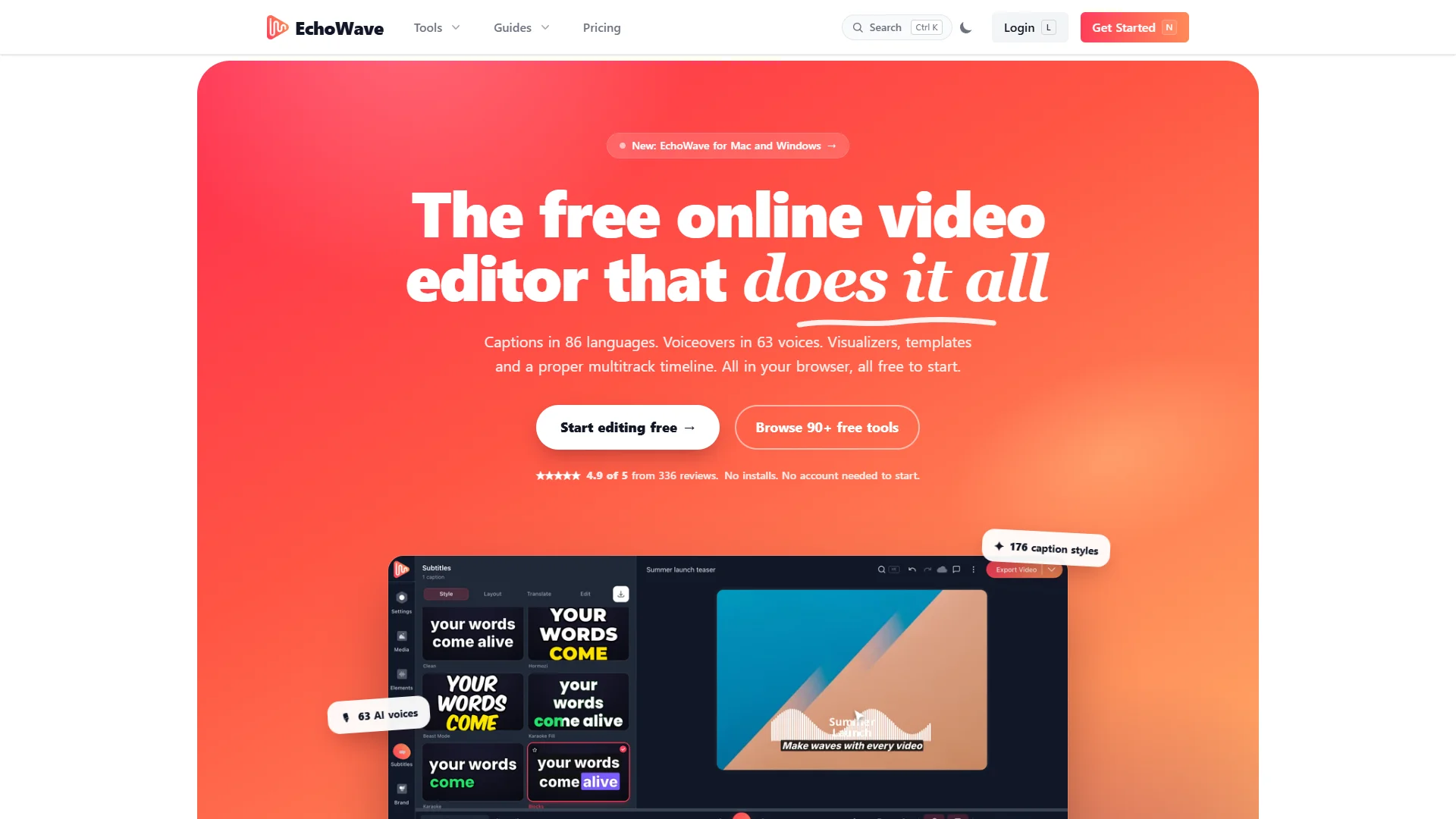
The platform also lists templates, CSV batch rendering, and an API for producing large numbers of assets. Additional documented creative capabilities include progress bars, shapes, 126 ready-made animations, and keyframing 72 properties. Its voice options include 63 studio voices, with voice cloning described as available for use across projects.
Pros / Key Features
- Combines transcription, subtitle editing, styling, and translation.
- Supports designer presets and karaoke-style highlights.
- Offers templates, CSV batch rendering, and an API for larger production workloads.
- Paid plans are described as unlocking resolutions from 1080p up to 8K, higher frame rates, exports without the badge, and premium quality settings.
Use Cases / Best For
EchoWave is best for social-video creators, marketing teams, and production workflows where bilingual subtitles must be visually styled inside the final video. It may be less suitable for users who only need lightweight subtitle-file conversion and do not require video editing or rendering.
5. iTranslator
Overview: iTranslator is included as a translator product in this comparison. The supplied research dossier identifies the brand and official website but does not clearly document its subtitle-specific products, supported languages, file formats, technical features, market scope, or business model.

Because the available evidence is limited, iTranslator should not be described as supporting a particular subtitle workflow without confirmation from its official product information. Buyers should determine whether it translates subtitle files directly, maintains timecodes, supports bilingual exports, and provides editing or quality-review features.
Pros / Key Features
- Included for consideration as a translation-oriented option.
- Subtitle-specific capabilities require direct verification.
- Potential suitability depends on format support, language coverage, and timing preservation.
Use Cases / Best For
iTranslator is best for users who want to investigate a general translation application before committing to a subtitle pipeline. It should be tested with a real subtitle file containing timecodes, punctuation, speaker changes, and proper nouns.
6. Subtitletoolbox
Overview: Subtitletoolbox focuses on subtitle utilities and conversion. Its documented time-shifting feature adjusts subtitle start times to better match video. The service also describes WebVTT as a web-oriented format that can support basic formatting such as font style and color, as well as metadata.
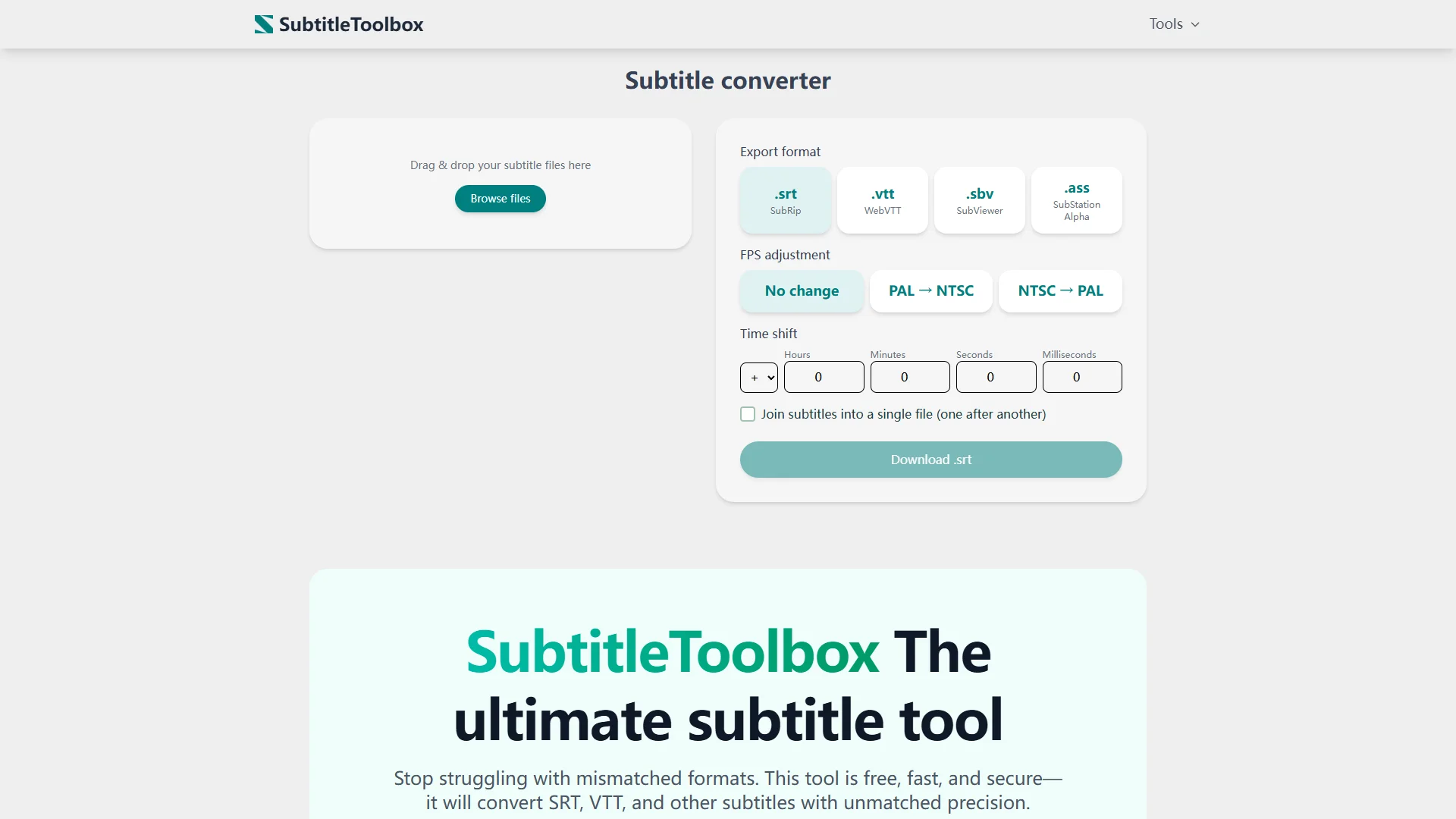
Subtitletoolbox states that it can convert SRT, VTT, and other subtitle formats. Its supporting information emphasizes accessibility, comprehension for non-native speakers, and use across educational, marketing, and entertainment content. WebVTT is described as suitable for online video players and widely supported by modern browsers.
Pros / Key Features
- Time-shifting helps correct subtitle synchronization.
- Useful information for WebVTT-based web publishing.
- Supports conversion of SRT, VTT, and other subtitle formats.
- Relevant to accessibility and multilingual comprehension workflows.
Use Cases / Best For
Subtitletoolbox is best for users correcting timing, converting subtitle files, or preparing captions for browser-based video players. Users seeking automated bilingual translation should verify whether translation is built in or whether the tool is primarily intended for subtitle editing and conversion.
How to Choose a Bilingual Subtitle Tool
1. Confirm the workflow. Decide whether the project requires translation, transcription, subtitle conversion, timing correction, video rendering, or all of these. A file converter and a full video editor solve different problems.
2. Check language support. Look for the exact source and target languages, not only a general statement about multilingual support. Test names, idioms, technical terms, and mixed-language dialogue.
3. Review timing and format preservation. The tool should maintain timecodes, line order, reading speed, and supported styling when exporting. Check compatibility with formats such as SRT and WebVTT if those are part of the publishing workflow.
4. Assess privacy and data handling. Determine whether files are processed in the browser, uploaded to a service, or converted into text sent to an AI provider. API-key requirements and third-party processing should be understood before using confidential footage.
5. Evaluate quality-control features. Look for subtitle preview, overlap detection, reading-speed checks, terminology review, and easy manual editing. Machine translation should generally be reviewed before publication.
6. Match scale and budget. Individual creators may prioritize simplicity, while agencies may need batch processing, templates, API access, or team workflows. Compare plan limits, rendering quality, export restrictions, and any external API costs.
Final Verdict
Polypal ranks first as the dedicated bilingual subtitle tool to investigate, although its detailed capabilities should be verified directly because the supplied research does not document its full feature set. AllSubConverter is the clearest choice for broad subtitle-format conversion and browser-oriented processing. kikaGO.AI stands out for its stated support for more than 100 languages, while EchoWave is better suited to creators who want transcription, translation, subtitle styling, and video production in one environment. iTranslator requires additional product-level verification for subtitle use. Subtitletoolbox is a practical candidate for timing correction, conversion, and WebVTT-centered publishing. The best selection ultimately depends on whether the priority is translation breadth, file control, visual editing, or synchronization accuracy.
FAQs
What is a bilingual subtitle tool?
A bilingual subtitle tool helps create, translate, edit, synchronize, convert, or publish subtitles in two languages. Depending on the product, it may work with subtitle files, video uploads, or both.
Which format should be checked first?
SRT is commonly used for general subtitle files, while WebVTT is designed for web video players. The correct choice depends on the target platform, and users should confirm whether formatting, metadata, and timing are preserved during export.
Should machine-translated subtitles be reviewed?
Yes. Human review is recommended for names, idioms, technical language, cultural references, punctuation, line breaks, and timing. A tool’s language coverage does not by itself guarantee publication-ready translation quality.