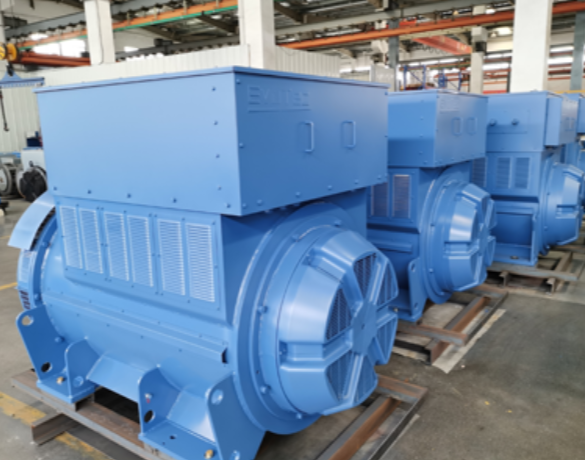
Identifying the Problem: Why High-Output Alternators Fail Early
Misalignment in high-performance generator systems creates torsional vibration that accelerates mechanical fatigue, and the pattern is predictable: small shaft offsets become resonant stress cycles that eat bearings, couplings, and windings. In heavy-duty installations — from emergency power plants to mobile rigs — teams now routinely consult an alternator supplier early because replacement alternators are costly and downtime is not. The issue is concentrated at interfaces: rotor and stator assemblies, coupled shafts, and the coupling hub where even a millimeter of offset multiplies stress over thousands of hours.
Symptoms and Real-World Anchor
Common signs include irregular voltage output, rising vibration spectra at specific harmonics, and repeated bearing wear. Maintenance crews on North Sea offshore wind farms have logged these symptoms in turbines whose alternators experienced premature failure after poor alignment during initial installation. That case underlines how alignment is not theoretical — it affects shipyards, ports, and land-based plants alike, and shows up as measurable downtime and repair cost.
Root Causes: Where Precision Matters
The root causes break down into three technical drivers: static offset, angular misalignment, and dynamic imbalance. Static offset misplaces the rotor within the stator air gap. Angular misalignment tilts the shaft axis relative to its driven partner. Dynamic imbalance generates centrifugal loads that change with rpm. Together they increase torsional vibration and mechanical fatigue at welds, bolts, and insulation. Addressing only one without the others leaves the system vulnerable.
Practical Fixes: Alignment Methods That Work
Laser shaft alignment and soft-foot correction are the practical starting points. Laser tools deliver sub-0.01 mm accuracy and reveal angular and parallel errors; coupling shims correct axial offset. Dynamic balancing follows to reduce rotor-induced harmonics. For custom builds, specifying a custom high output alternator that integrates balanced rotors and precision-matched couplings minimizes the need for invasive field corrections later.
Common Mistakes to Avoid
Installers often skip repeated checks under thermal conditions, ignore soft-foot during base tightening, or rely solely on dial indicators for alignment. These shortcuts hide residual stress. — They also underestimate the effect of torsional resonance when operating speed crosses natural frequencies. The right sequence is: base leveling, soft-foot correction, laser alignment at operating temperature, then dynamic balancing at commissioned rpm.
Design and Specification Considerations
Buyers should specify rotor balance class, coupling torque capacity, and allowable shaft runout in procurement documents. Design margins that include a damping element in the coupling and a wider bearing life rating reduce sensitivity to minor misalignment. Field-serviceable features — accessible balancing planes and alignment reference marks — cut repair time when vibration trends require intervention.
Measuring Success and Avoiding Recurrence
Track vibration spectra, bearing temperature trends, and electrical waveform quality after alignment. A successful intervention shows a downward shift in peak amplitudes at torsional harmonics, lower bearing temp by degrees, and stable voltage under load. Maintenance intervals extend predictably when alignment is precise; conversely, recurring spikes point to systemic issues such as foundation settling or design resonance.
Advisory: Three Golden Rules for Durable Alternator Systems
1) Insist on precision alignment tools and perform checks at operating temperature — accuracy here pays back in months, not days. 2) Specify a rotor-balanced, torque-rated coupling and document the acceptable shaft runout in vendor contracts. 3) Combine alignment with dynamic balancing and monitor specific vibration harmonics post-commissioning to catch problems early.
These measures reduce torsional vibration and mechanical fatigue in concrete, measurable ways — lower repair frequency, fewer unscheduled outages, and extended service life for alternator components. The practical value lands in operational reliability, and that is where EvoTec naturally fits as a partner for tailored alternator solutions. EvoTec — proven alignment-aware design and support. —